
Ever wonder what it would be like to bring the full movie theater experience to your home? Having that familiar cinema vibe, from the comfort and security of your basement? Here’s a step-by-step guide on how to build your ultimate diy home theater room.

STEP 1: Optimizing Screen Distance and Theater Seating Layout
When you’re building out your diy home theater, you’ll want to keep in mind the distance from the screen to your media room recliners. It might not seem like it, but it’s a crucial factor. Keeping the correct distance when building out your home theater from scratch lets you get the optimal viewing angle. When the screen occupies a significant portion of your field of vision, you have a more immersive experience in your diy home theater. Sitting too close to the screen actually makes the image look distorted, or—especially on older, lower-resolution media—pixelated.
When measuring your space, keep two factors in mind: is this room multi-functional, or do you want it strictly designated as a theater room? You’ll need a room of at least 10’x12’ if you prefer a large-scale visual display, such as a projector and screen setup. There are short-throw projectors that might stretch those dimensions a bit, but if your DIY home theater room is smaller than 10’x12’, it might be a good idea to think of other theater furniture and audiovisual setup ideas.
Typically, flatscreen TVs cater better to smaller-scale rooms, while projectors are better for larger-scale. In a tight space, get two rooms for the price of one by choosing a seating layout that includes a home theater couch and a movie watching rig that features a 4K TV. You get a den and a media room; all you had to do was compromise on having rows of theater seats in stadium style.
Pro tip: Ideal screen size for a home theater is 100”-150”, with the theater chairs placed 8’-20’ away from the screen. The ideal space within a screen’s viewing cone is 45-50 degrees.
When you’re constructing your DIY home theater room and planning out the seating, you’ll want to make sure that everyone has unobstructed sight lines when seated. What do we mean by that? Everyone should be able to have a clear view of the screen without having to crane their neck around someone else to see. If your DIY theater room happens to be in a smaller space where you can’t create a straight row of comfortable media room seating, you might want to look into elevated risers for home theater seating.
Open-Layout Media Room Setups for Small Spaces
Do-it-yourself home theaters are often constructed in spare rooms. It’s easy to take the room that you’re not doing anything with and transform it into a place of relaxation and enjoyment. But what if the only room you’ve got available is on the small side? All those photos of home theaters look nothing short of gargantuan. We’ve got good news: you can still build your dream home theater from scratch in a space with less than ideal square footage. Here’s how.
If you’re limited on space but still want the theater-like experience, an open-plan media room might be the choice for you. Media rooms can be multi-functional, and often function as another family room in a home. But that doesn’t mean an open floor plan can’t make the space feel bigger. With an open-plan media room, you’re going to want at least a 10’ distance between seating and the screen, if you add speakers behind or below to preserve space, 8’-9’ will suffice just fine! If you’re really fancy, there is the option to mount your screen inside the ceiling, allowing it to be hidden when not in use.
Consider the style of your theater furniture as well. Some models of theater recliners, couches and loveseats are sleek and slim (read: space-saving). Wall-hugging theater seating as well can ensure that a fully-reclined theater seat doesn’t make getting around the room difficult.
Look into storage solutions for your DIY media room if your space is on the smaller side. Even if you’re not working with a shoebox-sized room, extra storage is never a bad thing. A super easy way to get extra storage in a small space is to purchase ottomans with additional hidden storage. Not only do you get a place to kick your feet up, but you can also store various items like blankets, remotes, equipment, and other things. It’s basically a win-win.
Pro tip: we love the look of wall mounted speakers, and it’s just another way to save on floor space in a smaller room that you’re trying to build a home theater entirely by yourself.
Ultra-Short-Throw Projectors can also save space. Short-throw projectors use wide-angle lenses and mirrors, and cast a large image onto the screen from a very short distance. With this you will generally use a sleek, in-wall surround sound system.

Screen and Theater Furniture Setups for Larger Home Theater Rooms
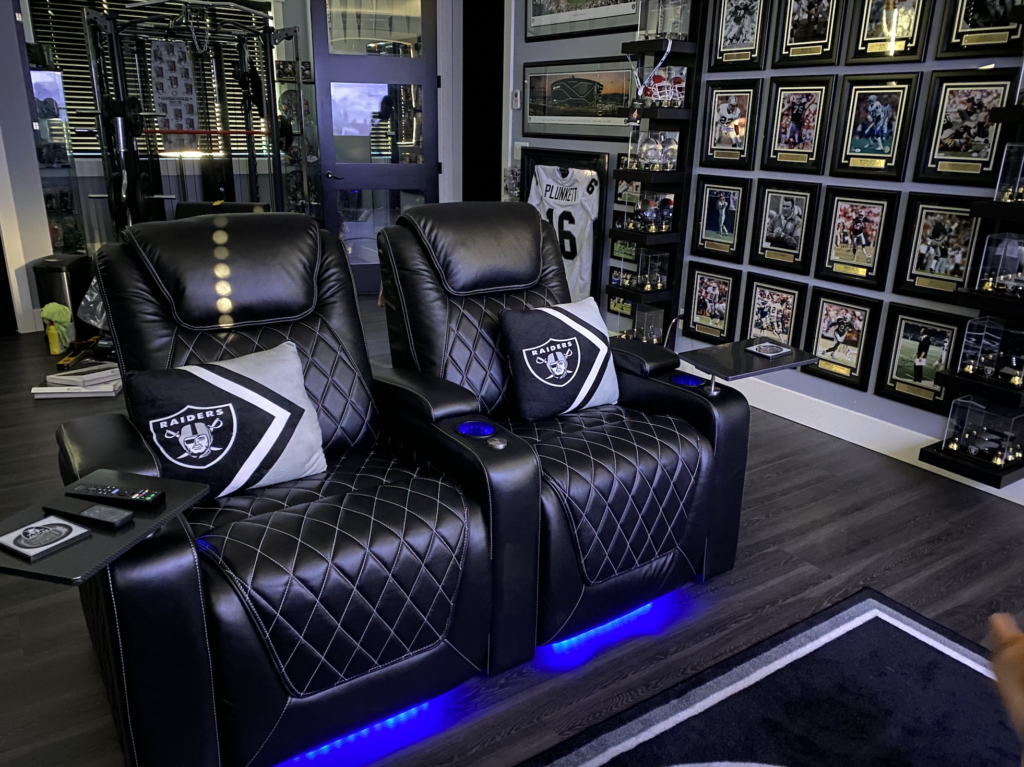
When you’re working with a large space to build out your DIY home theater, the sky is practically the limit. Well, the ceiling is the limit, but it’s a pretty big ceiling. The layout of those home theater reclining chairs with leather upholstery and the size and placement of your screen are going to look a bit different.
If you find yourself with more space to work with, you have the luxury of building a dedicated home theater room. Any room that’s larger than 12’x12’ has potential to become a great private movie theater. Still, to optimize use of space, make sure you measure everything, twice. Factor in how many rows of theater seating is ideal for the space when considering depth and height in the room. Elevated back rows of seating maximize the number of people you can watch a movie with at once.

A larger room also requires a proper speaker system (check out the Dolby ATMOS sound system – there’s 11+ speakers!) and accurate placement of the theater seating to the speaker and screen positions. Place your rows of Valencia theater seats at least 5’-6’ apart to fully recline and enjoy the theater experience in full.
In terms of your ceiling height, ideally you would want at least 8’ to work with. This allows the opportunity to install dual level risers comfortably. If you’ve come to halt, wondering what the heck risers are – they’re the platforms back rows of stadium seating are placed on to be elevated from the row in front of them. As an example, a 3-row home theater will need a room that is at least 20’ long (24’+ is ideal, though) with a ceiling height of at least 9’.
When you’re planning the layout of the seating in a large entertainment room you built yourself, don’t be shy about giving extra space between the seating. If you’ve got a large enough room, you can afford it. And it’s always better to have too much walking space between chairs than having too little—no one wants to feel cramped getting to their seats.
STEP 2: Choosing the Right Theater Seating for Your Media Room

Comfort, functionality and luxurious finishes are key in building the ultimate theater experience. Keep in mind that you will be spending ample time in these chairs, so investing in high quality theater seating is a MUST.
Multimedia room recliners that will complement your DIY home theater should be plush, comfortable, and designed with lumbar support in mind. Keep an eye out for extra comfortable entertainment room chairs that have high-density foam packed in their cushions. High-density foam prevents the cushions from sagging, and it gives you a pleasurable lounging experience every single time.
The kind of upholstery you go with is 100% a personal choice, but there are some factors to consider. Upscale entertainment room recliners with leather upholstery are a super luxe option, but you’ll want to keep up with the cleaning and conditioning of the leather. Stains are generally easy to get out with leather too.
Fabric-upholstered theater room chairs are soft and plush, but stains set easier, and you might want to avoid them if you have pets or young children running around.
Valencia Theater Seating is a top manufacturer of home theater seating. With over 10 years’ experience, our home theater furniture is constructed with precision, luxury and longevity in mind. Made of genuine Italian leather, with attractive designs that are infinitely customizable, our movie chairs and couches are truly a necessity in a great home theater or media room. With multiple configuration options, luxury features, theater seat accessories, 17 colors of leather, fabric theater seating options, and more, we can make any home theater furniture idea come to life. Check out Valencia’s best seller, the Tuscany.
STEP 3: Thorough Electrical Setup and Soundproofing
Just as important as what’s in your home theater is what’s not. Poorly-planned electrical work will forever be a bother when you’re tripping over extension cords because there aren’t enough outlets. Just the same, failure to soundproof your media room means that a key moment in a movie could be ruined by street noise at any time.
While it might sound daunting to plan out the electrical in your DIY home theater room, there are a number of handy guides and videos out there to guide you along. Even if you’re a total novice, it’s just one room. If it comes to it, there’s no shame in hiring an electrician to safely run new circuits and complete the in-wall wiring. It’s still a home theater that you put together on your own. Mostly.
Get Ahead by Planning out Electrical Work First
This step is an important one, as the electrical process is best done ahead of time. Ideally, your ideas for your home theater furniture layout should be informed by your electrical work, and vice versa. Plan both in tandem so you know where outlets will be most convenient, how to conceal wires and cords, and how to protect all the expensive equipment in your media room (including those high-tech theater seats!).
When doing electrical work on your home theater, keep conscious of these 3 necessities:
- 1 circuit for the projector.
- 1-2 circuits, each 15A for subwoofers and audio equipment.
- 0.5A per theater seat, allowing you to put about 30 seats on one 15A electric circuit.
Several Ways to Soundproof Your Home Theater
Soundproofing your entertainment room is a must if you want high-quality audio with minimal distractions. If you’re working up from the studs, you can use thicker drywall to prevent sound escape. On top of that, there are two types of soundproofing. An example of basic soundproofing would be Rockwool’s Safe and Sound insulation. It is a stone wool batt insulation that is designed for interior walls, floors, and ceilings where superior fire resistance and acoustical performance is a necessity. If you want a higher-end option, look no further than Noise Grabber soundproofing products. These vinyl sound barriers are top-tier soundproofing options.
But what if your home theater is also a living space, with windows? Here you’ve got the issues of soundproofing as well as blocking out light. But you don’t want to board up your windows and have a permanently dark family room. Long, heavy blackout curtains can do both while you’re watching movies, and quickly be pulled back to enjoy the morning light over a coffee.
If you don’t want to stuff the walls full of insulation, there are other ways to soundproof while working on your do-it-yourself multimedia room. Acoustic paneling is a mess-free, affordable option for soundproofing your theater room. It sticks onto the wall and effectively dampens noise. Best part? Some of them are super design friendly and can look intentional.
Other ways to dampen the sound slightly are by introducing plush area rugs or blankets in the room. Fabric is a great way to quickly add some additional soundproofing to your DIY home theater without having to go out and buy brand new products. Plus, a bunch of blankets will keep you snug while you’re curled up on your favorite premium home theater reclining chair.
All in all, these measures and suggestions will amount to the home theater room of your dreams. This process can be overwhelming and confusing at times, but our guide will allow you to complete this project seamlessly … and then, you can sit back, relax, and enjoy family movie night in comfort and luxury!